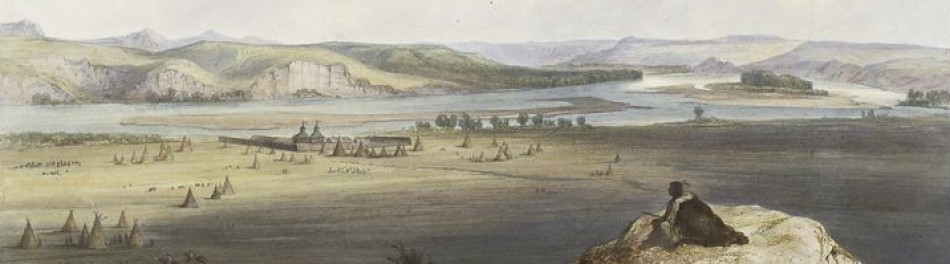
Regeneration Through Violence
The Lower Manhattan Cultural Council sponsors a lecture series under the rubric “Access Restricted,” which has served to introduce their audiences to spaces in lower Manhattan of some historical significance, that are prohibited, hidden or rarely open to the general public. I attended one of LMCC’s programs the other night — a panel discussion entitled “At the Intersection: Art, Money and Politics” at the Léman Manhattan Preparatory School located near the intersection of Broad and Wall Streets. The discussion wasn’t quite what I was expecting, but it turned out to be worthwhile in ways I could not have anticipated. The focus of the discussion quickly became what it means to live, work and make art under what one panelist labeled “bonanza capitalism” after tying that notion to the myth of the U.S. frontier and referencing Richard Slotkin. I didn’t work in a college bookstore all those years for nothing. Regeneration Through Violence (1973) popped into my head right away at the mention of Slotkin. Still, I was surprised to hear his name being invoked. The connection being drawn between western frontier mythos and the New York Stock Exchange (just across the street from where I sat) felt a bit dodgy. An old bookstore clerk, I often think of books in bunches. One book title elicits another book title. Reading lists for long-ago classes linger at the back of the mind, required versus recommended books (never order as many as the required). Virgin Land begets The American Adam begets Regeneration Through Violence. To this group I might add, Lawrence’s Studies in Classic American Lit and Leslie Fiedler’s Love and Death in the American Novel – not because I had read much of this stuff, mind you. My associations are based on how books were arranged on shelves for various classes, but it is interesting what caught my eye out of all there was to catch my eye and what remained lodged in one or two grey cells from all those years ago. American Studies with a literary bent, back when it was assumed America = U.S.A. I could add a few more titles. These books — from different historical moments: the Twenties, the Cold War, the Sixties — are attempts to grapple with the meaning of America, how Americans imagine themselves and are imagined by others across time. Regeneration Through Violence was published in the wake of the Vietnam War.
As luck would have it, when I got home after the LMCC event, I found my old copy of Slotkin ready to hand. (I’ve been combing through my books recently, pulling out stuff that might prove pertinent to this blog.) I had forgotten the subtitle: “The Mythology of the American Frontier, 1600-1800.” The idea of “the frontier” shifts and evolves over time and so do the ways in which these ideas are put to use. The frontier marks the divide between “us” and “them, between “Cannibals and Christians,” between civilization and barbarism. But on which side of the frontier is civilization and where is barbarism located? The frontier provides the space for Europeans to shed their Old World corruption and become Americans or to revert back to “Natural Man.” Perhaps this begins to point to the connection between notions of the frontier and the NYSE located as it is in the oldest, historical part of “Mannahatta” (the Lenape name for Manhattan). Can we trace a direct line from Natty Bumpo and Daniel Boone to the self-made men and rugged individualists of Wall Street?
 Cowboys und Indianer