Cowboys und Indianer

A Capstone Project of Weimar in America

Happy New Year!

It’s been awhile, I know.  Not quite able to climb back in the saddle yet, but wanted to post this translation of a missive sent in response to predictions of a Mayan apocalypse:

Communiqué from the Indigenous Revolutionary Clandestine Committee – General Command of the Zapatista National Liberation Army Mexico. December 30 2012.

To the People of Mexico: To the People and Governments of the World: Brothers and Sisters: Female and Male Comrades:

In the early morning hours of December 21, 2012, tens of thousands of indigenous Zapatistas mobilized and took, peacefully and silently, five municipal seats in the southeast Mexican state of Chiapas.

In the cities of Palenque, Altamirano, Las Margaritas, Ocosingo, and San Cristóbal de las Casas, we looked at you and at ourselves in silence.

Ours is not a message of resignation.

It is not one of war, death, or destruction.

Our message is one of struggle and resistance.

After the media coup d’etat that catapulted a poorly concealed and even more poorly costumed ignorance into the federal executive branch, we made ourselves present to let them know that if they had never left, neither had we.

Six years ago, a segment of the political and intellectual class went looking for someone to hold responsible for their defeat2. At that time we were, in cities and in communities, struggling for justice for an Atenco that was not yet fashionable.

In that yesterday, they slandered us first and wanted to silence us later.

Dishonest and incapable of seeing that it was within themselves that there was and still is the seed of their own destruction, they tried to make us disappear with lies and complicit silence. Six years later, two things are clear:

They don’t need us in order to fail.

We don’t need them in order to survive.

We, who never went away, despite what media across the spectrum have been determined to make you believe, resurge as the indigenous Zapatistas that we are and will be.

In these years, we have significantly strengthened and improved our living conditions. Our standard of living is higher than those of the indigenous communities that support the governments in office, who receive handouts that are squandered on alcohol and useless items.

Our homes have improved without damaging nature by imposing on it roads alien to it.

In our communities, the earth that was used to fatten the cattle of ranchers and landlords is now used to produce the maize, beans, and the vegetables that brighten our tables.

Our work has the double satisfaction of providing us with what we need to live honorably and contributing to the collective growth of our communities.

Our sons and daughters go to a school that teaches them their own history, that of their country and that of the world, as well as the sciences and techniques necessary for them to grow without ceasing to be indigenous.

Indigenous Zapatista women are not sold as commodities.

The indigenous members of the PRI attend our hospitals, clinics, and laboratories because in those of the government, there is no medicine, nor medical devices, nor doctors, nor qualified personnel.

Our culture flourishes, not isolated, but enriched through contact with the cultures of other peoples of Mexico and of the world.

We govern and govern ourselves, always looking first for agreement before confrontation.

We have achieved all of this without the government, the political class, and the media that accompanies them, while simultaneously resisting their attacks of all kinds.

We have shown, once again, that we are who we are.

With our silence, we have made ourselves present.

Now with our word, we announce that:

First – We will reaffirm and consolidate our participation in the National Indigenous Congress, the space of encounter with the original peoples of our country.

Second – We will reinitiate contact with our compañeros and compañeras adherents of the Sixth Declaration of the Lacandón Jungle in Mexico and the world.

Third – We will try to construct the necessary bridges toward the social movements that have arisen and will arise, not to direct or supplant them, but to learn from them, from their history, from their paths and destinies.

For this we have consolidated the support of individuals and groups in different parts of Mexico, formed as support teams for the Sixth and International Commissions of the EZLN, to become avenues of communication between the Zapatista bases of support and the individuals, groups, and collectives that are adherents to the Sixth Declaration, in Mexico and in the World, who still maintain their conviction and commitment to the construction of a non-institutional left alternative.

Fourth – We will continue to maintain our critical distance with respect to the entirety of the Mexican political class which has thrived at the expense of the needs and desires of humble and simple people.

Fifth – With respect to the bad governments – federal, state, and municipal, executive, legislative, and judicial, and the media that accompanies them, we say the following:

The bad governments which belong to the entirety of the political spectrum without a single exception have done everything possible to destroy us, to buy us off, to make us surrender. PRI, PAN, PRD, PVEM, PT, CC and the future political party RN have attacked us militarily, politically, socially, and ideologically.[i] The mainstream media tried to disappear us first with opportunist and servile lies followed by a complicit and deceptive silence. Those they served, those on whose money they nursed are no longer around and those who have succeeded them will not last any longer than their predecessors.

As was made evident on December 21, 2012, all of them failed. So, it’s up to the federal, executive, legislative and judicial governments to decide if they are going to continue the politics of counterinsurgency that have only resulted in a flimsy simulation clumsily built through the media, or if they are going to recognize and fulfill their commitments by elevating Indigenous Rights and Culture to the level of the Constitution as established in the “San Andrés Accords” signed by the Federal Government in 1996, which was at the time led by the very same political party that today occupies the executive office.

It will be up to the state government to decide if it will continue the dishonest and despicable strategy of its predecessor, that in addition to corruption and lies, used the money of the people of Chiapas to enrich itself and its accomplices and dedicated itself to the shameless buying off of the voices and pens of the communications media, sinking the people of Chiapas into poverty while using police and paramilitaries to try to brake the organizational advance of the Zapatista communities; or, if instead, with truth and justice, it will accept and respect our existence and come around to the idea that a new form of social life is blooming in Zapatista territory, Chiapas, Mexico. This is a flowering that attracts the attention of honest people all over the planet.

It will be up to the municipal governments if they decide to keep swallowing the tall tales with which anti-zapatista or supposedly “zapatista” organizations extort them in order to attack and harass our communities; or if instead they use that money to improve the living conditions of those they govern.

It will be up to the people of Mexico who organize in electoral struggles and resist, to decide if they will continue to see us as enemies or rivals upon which to take out their frustration over the frauds and aggressions that, in the end, affect all of us, and if in their struggle for power they continue to ally themselves with our persecutors; or if they finally recognize in us another form of doing politics. Sixth – In the next few days, the EZLN, through its Sixth and International Commissions, will announce a series of initiatives, civil and peaceful, to continue walking together with other original peoples of Mexico and of the continent, and together with those in Mexico and the world who struggle and resist below and to the left.

Brothers and Sisters: Compañeros and Compañeras:

Before we had the good fortune of the honest and noble attention of various communications media. We expressed our appreciation then. But this has been completely erased by their later attitude.

Those who wagered that we only existed in the communications media and that, with the siege of lies and silence they created we would disappear, were mistaken.

When there were no cameras, microphones, pens, ears, or gazes, we continued to exist.

When they slandered us, we continued to exist.

When they silenced us, we continued to exist.

And here we are, existing.

Our path, as has been demonstrated, does not depend on media impact, but rather on comprehending the world and all of its parts, on indigenous wisdom that guides our steps, on the unswerving decision that is the dignity of below and to the left.

From now on, our word will be selective in its destination and, except on limited occasions, will only be able to be understood by those who have walked with us and who continue to walk without surrendering to current or media trends.

Here, not without many mistakes and many difficulties, another form of doing politics is already a reality.

Few, very few, will have the privilege of knowing it and learning from it directly.

19 years ago we surprised them taking with fire and blood their cities. Now we have done it once again, without arms, without death, without destruction.

In this way we have distinguished ourselves from those who, during their governments, distributed and continue to distribute death among those they govern.

We are those, the same, of 500 years ago, of 44 years ago, of 30 years ago, of 20 years ago, of just a few days ago.

We are the Zapatistas, the very smallest, those that live, struggle, and die in the last corner of the country, those that do not give up, do not sell out, those that do not surrender.

Brothers and Sisters: Comrades,

We are the Zapatistas, receive our embrace.

DEMOCRACY!

LIBERTY!

JUSTICE!

From the mountains of the Mexican Southeast. For the Indigenous Revolutionary Clandestine Committee—General Command of the Zapatista Army for National Liberation.

Subcomandante Insurgente Marcos. Mexico. December of 2012 – January of 2013.

[i] PRI (the party of the 70 year dictatorship and home of former president Carlos Salinas de Gortari); PAN (the right-wing party of recent president Felipe Calderón which oversaw the total devastation and the deaths of tens of thousands of Mexicans due to its “war on drugs” during the last twelve years); PRD (the institutional “left” party which hired former NYC Mayor Rudolph Giuliani as consultant to apply “Zero Tolerance” in Mexico City and joined the PAN and the PRI in blocking constitutional reforms on Indigenous Rights and Culture and which until recently was the party of Andrés Manuel López Obrador); the PVEM (Partido Verde Ecologista de México), PT (Partido del Trabajo), CC (Convergencia Ciudadana) and RN (Regeneración Nacional, the political party that is now being built by Andrés Manuel López Obrador after his friendly exit from the PRD).

2) Intellectuals and journalists supporting the institutional “left” party which hired former NYC Mayor Rudolph Giuliani as consultant to apply “Zero Tolerance” in Mexico City and joined the PAN and the PRI in blocking constitutional reforms on Indigenous Rights and Culture and which until recently was the party of Andrés Manuel López Obrador.

The Wisconsin Idea

It’s been awhile.  I’ve been spending a lot of time trying not to finish writing my master’s thesis and figured I could partially assuage my conscious by not blogging!  Mitt Romney’s selection of Paul Ryan pushed me into coming back — or rather recent news coverage of his V.P. pick aroused my curiousity and, well, here I am. 

One of the recent tropes being propagated by the “liberal media” is Paul Ryan’s April 10, 2010 interview on Glenn Beck’s radio show.  Let us bow our heads in humble gratitude to the anonymous techie(s) who memorialized and preserved it.  On the Glenn Beck video, we get to hear Ryan (he’s not physically present at the radio station) pontificate on why progressivism is evil.  During the course of this speech, Ryan situates himself as someone who grew up in Janesville, Wisconsin (a Democratic stronghold in the last presidential election) and who therefore has special knowledge about the progressive goings-on in Madison, Wisconsin, as he says, just “35 miles” away.

I grew up hearing about this stuff.  This stuff came from these German intellectuals to Madison-University of Wisconsin and sort of out there from the beginning of the last century.  So this is something we are familiar with where I come from.  It never sat right with me. . . .  [Progressivism] is really a cancer because it basically takes the notion that our rights come from God and nature and turns it on its head and says, no, no, no, no, no, they come from government, and we here in government are here to give you your rights and therefore ration, redistribute and regulate your rights.  It’s a complete affront to the whole idea of this country . . . .

So, what “stuff” and which “German intellectuals” and why Madison, Wisconsin?  The idea that German intellectuals are the source of progressivism in Wisconsin seems to have its roots in a 1912 publication by Charles McCarthy entitled, The Wisconsin Idea.  According to Jack Stark writing partly to rebut McCarthy’s thesis in 1995, McCarthy credits the influence of primarily one professor, Richard Ely, who studied in Germany, as well as the presence of many people of German descent in Wisconsin (“fundamentally a German state”) with shaping the way “The Wisconsin Idea” came to fruition.  Stark characterizes McCarthy as a “devoted Progressive” who wrote his book as an appeal to the many German-American voters in the state, where the competing Socialist Party was making inroads into the Progressives’ base!

Like Stark, John Nichols of The Nation, locates “The Wisconsin Idea” within the context of a broader progressive movement.  Nichols’ article points to Robert La Follette who led the formation of a progressive wing from within the Republican party, which he believed had moved away from its antislavery platform and been taken over by the railroad and other corporate interests.  This reformist wing (known as “Insurgents”) challenged the “Stalwarts” for leadership of the Republican party and La Follette was nominated for governor of Wisconsin.  He was elected governor in 1900.  In 1924, as head of the Progressive Party, La Follette ran for President of the United States, receiving 17% of the popular vote.

As Nichols details it, La Follette spent a major portion of his life fighting what he and other Progressives called “the money power,”  that is, the impact of corporate capital on politics and social policy.  Progressives were discussing a national healthcare system as early as 1900.  They also believed that government should use its power to prevent monopolization of industries and they favored nationalizing railroads and utilities.    La Follette and his party supported cuts to military spending and reform of the tax system to punish profiteering and “the indefinite accumulation by inheritance of great fortunes in a few hands.”

But what about Paul Ryan and his “German intellectuals”?  she asked — Germans, as opposed to the “Austrian economists” that along with Ayn Rand apparently have Ryan’s approval.  A blogpost at dailykos.com suggests a possible answer worth exploring:

a lot of anti-liberal slurs have their roots in anti-semitism to some degree or another: rootless cosmopolitans, morally and sexually depraved, godless secular humanists, effete urbanites, not heartland farmers, not christians, nerds, lawyers, san francisco, new york city, upper west side, hollywood, commies in academia, etc. etc.

Dogwhistle anti-semitism?  One last thing, as far as we know, despite his antipathy to government intervention, Ryan never returned the Social Security survivor benefit checks he received after the death of his father.  Oh, and — his family’s business was built on government-subsidized construction projects (i.e. government contracts).  We should also not forget Ryan’s muse, Ayn Rand.  Rand, in her decrepit old age, was not above signing up for both Social Security and Medicare; however, in keeping with her philosophy, she did sign up reluctantly and in her own self-interest.

Harlem on the Prairie

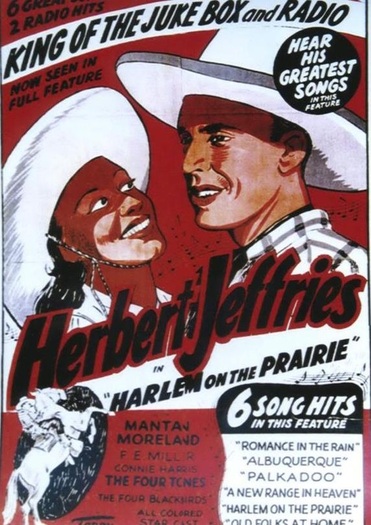
“Most people come to this world by stork.  I came by flamingo, and Duke Ellington delivered me.”  – Herb Jeffries. 

I call this blog “Cowboys und Indianer” and not “Cowboys and Indians” to suggest not only the German explorers who are part of my subject, but also that there is something just a little bit “off” about this enterprise.  I’m not really interested in doing anthropology.  This is not ethnography.   Think of this as something more akin to psychotherapy — social or cultural psychotherapy.  It’s about how and what we imagine.  It’s about dreams.  Crazy dreams.  Some crazy dreams can lead to murder.  Sometimes they’re good for a laugh and sometimes they just leave you stumped, not knowing quite how to respond.  Then you remember, well, it is a dream after all.  Nothing to do with reality  — maybe.

Herb Jeffries was born in Detroit in 1913.  He became a singer with the Duke Ellington Orchestra and the star of black westerns in Hollywood.  You say you didn’t know Hollywood made black westerns.  Neither did I.  Check out Richard Friswell’s website (here).  I can’t tell whether Friswell’s site is a work-in-progress or has been abandoned, but it’s still worth a look.  He locates Jeffries’ career in the sociocultural tumult between the two World Wars.  Dislocations brought about by WWI would contribute to some destabilization of notions about race and racial identities in black communities, if not in the country as a whole.  For just one example, see Alain Locke’s The New Negro published in 1925.  For another example, see the career of Herb Jeffries as Friswell has detailed it.

Charles “The Monk” Sealsfield

What we know about the life of Carl Anton Postl (1793-1864) could easily be mistaken for the plot of a Gothic novel written by Matthew Lewis or E.T.A. Hoffman:  A Moravian monk walks out of his monastery and disappears into the ether — not seen or heard from by friends or family for over 40 years — until it is discovered that he had been living in New Orleans under an assumed name, Charles Sealsfield.  He also lived for sometime in both New York and Pennsylvania.  A peripatetic spirit, Postl/Sealsfield alternated bouts of writing with extended periods of travel in North America.  Born in the village of Poppitz, Moravia, Postl returned to Europe on a number of occasions.  There is some speculation that he owned a plantation on the Red River, but there is no definitive evidence to support that.  Jeffrey L. Sammons has revealed that for some time in 1830, Postl was associated with a newspaper (Courrier des Etats-Unis) in New York that was owned by Joseph Bonaparte, the former king of Naples and of Spain, then resident in New Jersey!

Charles Sealsfield

Postl, as Sealsfield, wrote over a dozen novels and commentaries/travelogues on North America and Europe.  His 1841 novel Das Kajütenbuch (The Cabin Book), depicting Texas as a land of plenty and personal freedom, was immensely popular in both Europe and America in the 19th century.  This book, along with others published at the time in a similar vein, helped spur German immigration through the organization of the Adelsverein or German Emigration Company in 1842 — the official title of the organization translated into English was “Society for the Protection of German Immigrants in Texas.”

According to Sammons, Sealsfield’s fiction is another iteration of that weird moralistic dichotomy in which “Americans” are pictured as simple and chaste, Anglo-Saxon stalwarts (i.e. men), while people of “darker racial composition” constitute a culture apart.  This separate culture (often personified as Indian or Creole women or “The French”) poses a threat to “real” Americans through their “dangerous sensual magnetism.”  

A Mason and an admirer of Andrew Jackson’s politics, Sealsfield’s literary output was put to use in Nazi cultural politics.  In his “plantation novels,” Sealsfield gives vent to what Sammons, referencing C. Vann Woodward, classifies as a Herrenvolk ideology where slavery provides “the underpinning of a strictly white egalitarianism.”  Altogether Sealsfield spent only a few years in North America.  Most of his literary output was produced in Europe. 

Sources: 

Louis E. Brister, “ADELSVEREIN,” Handbook of Texas Online (http://www.tshaonline.org/handbook/online/articles/ufa01), accessed May 23, 2012. Published by the Texas State Historical Association.

Glen E. Lich, “POSTL, CARL ANTON,” Handbook of Texas Online (http://www.tshaonline.org/handbook/online/articles/fpods), accessed May 23, 2012. Published by the Texas State Historical Association

 Jeffrey L. Sammons, Ideology, Mimesis, Fantasy:  Charles Sealsfield, Friedrich Gerstäcker, Karl May, and Other German Novelists of America (Chapel Hill, The University of North Carolina Press, 1998).

Women Travelers in Latin America

The Americas Society is holding a three-day symposium on “Women Travelers in Latin America.”  I got home last night in time to watch most of the first event via webcast.

Lisabeth Paravisini-Gebert discussed the German naturalist and artist, Maria Sibylla Merian (1647-1717) who traveled to Suriname to study insect life in 1699 and authored Metamorphosis of the Insects of Suriname.  Flora Tristan (1803-1844) wrote about her travels in post-independence Peru in Peregrinations of a Pariah.  Vanesa Miseres discussed Tristan’s early interest in female agency in the context of Tristan’s liminal position as a female explorer and activist.  Adela Pineda Franco told the fascinating story of the Empress Carlota’s lady-in-waiting during Maximilian’s rule in Mexico, the Countess Paula Kollonitz (1830-1890).  Kollonitz, “a very sharp political analyst,” wrote a bestselling memoir of her time at the Mexican court that was published in several languages, but surprisingly not in Spanish until the mid-20th century.  Claire Emille Martin discussed the intrepid adventurer and Scottish noblewomen, Lady Florence Dixie (1855-1905), who traveled in Patagonia and South Africa.  The webcast of last night’s proceedings were still up for re-viewing at the time of this posting.

Hände hoch! (Hands up!)

The 2012 Karl May Festival entitled “Vom Greenhorn zum Evergreen” will be held in Radebeul, Germany from May 18-20.  At the website for the fest, you can download a 40-page program — in German only, alas!  The program contains a map showing the route of the “Santa- Fé-Express” that will carry visitors from Radebeul-Ost to Lössnitzgrund and the festival locales in-between.   Karl May enthusiasts dressed up as Old Shatterhand or his faithful sidekick, Winnetou, can participate in Wild West reenactments, buy cowboy boots, or attend a pow-wow hosted by members of the Navajo Nation or by Peigan-Blackfoot Indians from Alberta, Canada.

Even with no knowledge of German, it’s clear from the program that “2012 ist ein besonderes Jahr in the der Chronik Karl Mays.”  Born on February 25, 1842, this year marks the 170th anniversary of Karl May’s birth.  “Who the hell is Karl May?” you may well be asking if you’ve bothered to read this far.  Karl May is simply one of the all-time bestselling authors of whom nobody, outside of the German-speaking world, has ever heard.

A grifter and petty thief who served multiple jail terms, May was born in  Ernstthal, Germany, the fifth of 14 children, few of whom survived infancy.  He grew up in extreme poverty and was blind for the first four years of his life, possibly as a result of the combined effects of nutritional deficiencies and childhood illness.  A gifted student despite these early disadvantages, May was headed for a promising teaching career until his propensity for taking things that did not belong to him brought an end to those plans.

In the introduction to his translation of Karl May’s novel Winnetou, David Koblick draws parallels between May’s personal history and the Horatio Alger tales.  Though German, May also evokes another all-American literary type — the “Confidence Man.”  His career as a swindler depended on his skill as a fabulist who constructed fake identities and impersonated police and other public officials.  His immense success as a writer was built on his ability to invent a vision of the American West that he himself never visited.

May put his time spent in prison to good use:  reading voraciously in what was already a considerable “western” literary canon written by Germans, writing, and collecting rejection slips from publishers.   Richard Cracroft suggests that the enduring popularity of Karl May’s fiction, as well as the failure of his work to catch on outside of Europe, is based on May giving us “the perfect Germanic hero” in Wild West drag.  Written after the Franco-Prussian War in a victorious Germany that was rapidly industrializing and urbanizing, Karl May’s tales of the Old West contributed to Germany’s nationalistic pride.  Old Shatterhand (known also as Karl der Deutsche) is Superman with a cape made of rawhide.

Source:

Karl May, Winnetou, translated and abridged by David Koblick, with a foreword by Richard H. Cracroft (Pullman: Washington State University Press, 1999).

Regeneration Through Violence

The Lower Manhattan Cultural Council sponsors a lecture series under the rubric “Access Restricted,” which has served to introduce their audiences to spaces in lower Manhattan of some historical significance, that are prohibited, hidden or rarely open to the general public.  I attended one of LMCC’s programs the other night — a panel discussion entitled “At the Intersection:  Art, Money and Politics” at the Léman Manhattan Preparatory School located near the intersection of Broad and Wall Streets.  The discussion wasn’t quite what I was expecting, but it turned out to be worthwhile in ways I could not have anticipated.  The focus of the discussion quickly became what it means to live, work and make art under what one panelist labeled “bonanza capitalism” after tying that notion to the myth of the U.S. frontier and referencing Richard Slotkin.  I didn’t work in a college bookstore all those years for nothing. Regeneration Through Violence (1973) popped into my head right away at the mention of Slotkin.  Still, I was surprised to hear his name being invoked.  The connection being drawn between western frontier mythos and the New York Stock Exchange (just across the street from where I sat) felt a bit dodgy.  An old bookstore clerk, I often think of books in bunches.  One book title elicits another book title.  Reading lists for long-ago classes linger at the back of the mind, required versus recommended books (never order as many as the required).  Virgin Land begets The American Adam begets Regeneration Through Violence.  To this group I might add, Lawrence’s Studies in Classic American Lit and Leslie Fiedler’s Love and Death in the American Novel – not because I had read much of this stuff, mind you.  My associations are based on how books were arranged on shelves for various classes, but it is interesting what caught my eye out of all there was to catch my eye and what remained lodged in one or two grey cells from all those years ago.  American Studies with a literary bent, back when it was assumed America = U.S.A.  I could add a few more titles.  These books — from different historical moments:  the Twenties, the Cold War, the Sixties — are attempts to grapple with the meaning of America, how Americans imagine themselves and are imagined by others across time.  Regeneration Through Violence was published in the wake of the Vietnam War.

As luck would have it, when I got home after the LMCC event, I found my old copy of Slotkin ready to hand.  (I’ve been combing through my books  recently, pulling out stuff that might prove pertinent to this blog.)  I had forgotten the subtitle:  “The Mythology of the American Frontier, 1600-1800.”  The idea of “the frontier” shifts and evolves over time and so do the ways in which these ideas are put to use.  The frontier marks the divide between “us” and “them, between “Cannibals and Christians,” between civilization and barbarism.  But on which side of the frontier is civilization and where is barbarism located?  The frontier provides the space for Europeans to shed their Old World corruption and become Americans or to revert back to “Natural Man.”  Perhaps this begins to point to the connection between notions of the frontier and the NYSE located as it is in the oldest, historical part of “Mannahatta” (the Lenape name for Manhattan).  Can we trace a direct line from Natty Bumpo and Daniel Boone to the self-made men and rugged individualists of Wall Street?

Alexander Humboldt & His “Offspring”

Alexander Humboldt (1773-1858), the great German scientist, explorer and humanist is the local spirit of this blog. 

In her book, The Passage to Cosmos:  Alexander von Humboldt and the Shaping of America, Laura Dassow Walls introduces the generation of scientists, explorers, artists and gentlemen travelers who would build on and extend Humboldt’s work (often with references and help provided by Humboldt himself).  Taken together, these explorers produced a body of literature that greatly influenced the way Europe and America envisioned the American West.  Unsurprisingly, given Humboldt’s influence and reach, many of these individuals were Germans:  Paul Wilhelm, Duke of Württemberg; Balduin Möllhausen; Maximilian, Prince of Wied; the artists Karl Bodmer and Albert Bierstadt; Frederick Wislizenus; Georg Engelmann and others.  Referencing the travel and writings of Möllhausen in a chapter entitled “Manifest Destinies,” Walls makes a passing comment about Karl May, who she calls “the best-selling German author of all time,” though he is hardly known outside Europe.  Karl May — this German JK Rowling or, perhaps more appropriately, the German Mark Twain of his time — enjoys a popularity among German-speakers that continues up to the present day.  May profited from and contributed to what Walls describes as “the powerful identification of Germans with the victimized American Indian” — an identification that has left its tracks across the writings of many of the inheritors of Alexander Humboldt’s legacy.  This blog sets out to follow these tracks to wherever they might lead us.

Post Navigation